Gloucester Township Roofing handles roof repair in Gloucester Township, NJ, serving surrounding cities including Pine Hill, Bellmawr, Woodbury, Haddonfield and Mantua, with more than 20 years spent fixing leaks, wind damage, worn flashing and tired flat roofs. We work on asphalt, slate, metal and low-slope membranes, on detached houses, townhouses and small commercial buildings, and every repair is quoted in writing before a single shingle comes up.
A roof repair only works when it fixes the spot where water actually gets in, so our visits start inside. We look in the attic for wet sheathing, stained rafters and daylight around penetrations, then go up and match what we saw to the roof surface. That order catches the leaks that travel several feet before they show on a ceiling.
You also get a straight answer on whether repair makes sense at all. Plenty of roofs only need a new pipe boot, a few shingles or a rebuilt flashing detail, and we will say so. When a roof has worn out across every slope, we explain why patching it would waste your money, and we show you the photographs that support that call.
Residential Roof Repair
Shingle Replacement and Wind Damage Repair
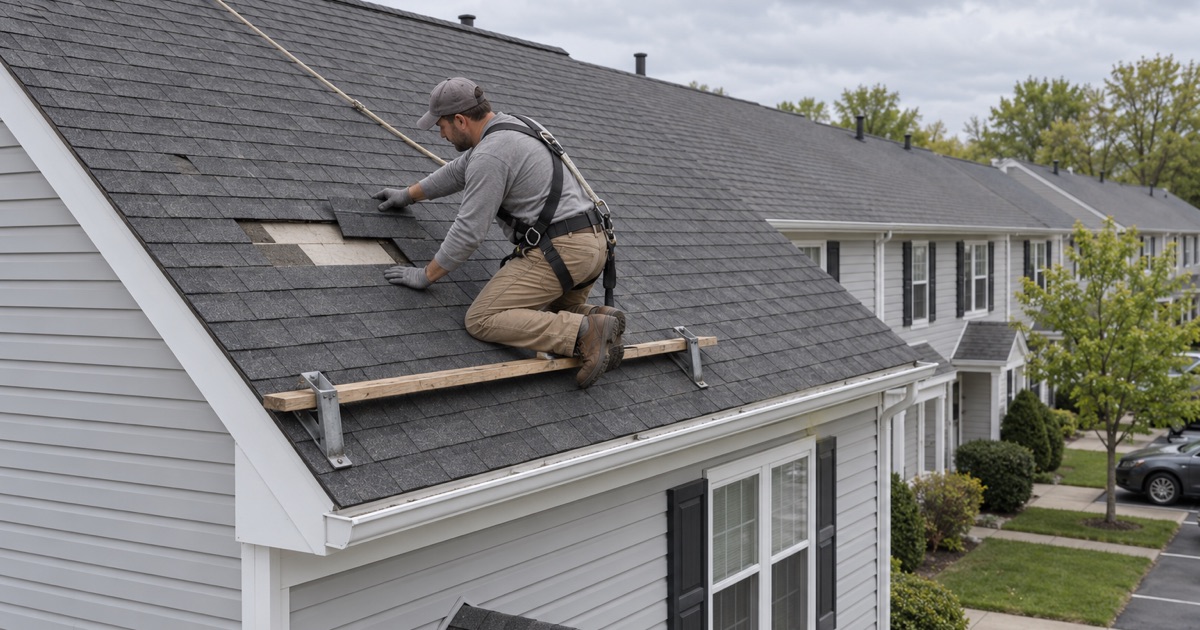
Wind lifts shingle edges, breaks the factory seal strip and sometimes tears whole pieces away, leaving nail heads and underlayment exposed. We slide out damaged shingles, replace them with a matching product where one is still made, and hand-seal the surrounding courses so the patch locks into the roof around it.
A repaired area is only as good as its nailing, so we check the fasteners on the courses above and below the damage too. Shingles that were nailed high or with too few nails on the original install tend to blow off again in the next storm, and fixing that pattern is often what stops a repeat call.
Flashing, Pipe Boot and Penetration Repairs
Most leaks on an otherwise healthy roof start at a penetration. Rubber pipe boots crack in the sun, step flashing along a sidewall loses its seal, and the counterflashing on a chimney pulls out of its mortar joint. We replace these parts with new boots, step flashing and counterflashing set into a cut reglet, rather than burying the old metal under roof cement.
Caulk and mastic patches look fine for a season and then shrink and split, which is why so many repeat leaks trace back to an earlier quick fix. Replacing the flashing itself costs a little more on the day, and it is the difference between a repair that holds and one that comes back next spring.
Decking, Fascia and Drip Edge Repairs
Water that has been getting in for a while rots the plywood deck, the fascia board behind the gutter and sometimes the ends of the rafters. Once we open the roof, any soft sheathing is photographed and shown to you, then replaced at the per-sheet price written into your contract before work began.
At the eaves we replace rotted fascia, install drip edge so water clears the board, and rehang the gutter on solid wood. Skipping the drip edge is one of the most common reasons fascia rots in the first place, so we add it wherever it is missing.
Commercial Roof Repair
Low-Slope Membrane Repairs
Retail, office and light industrial buildings usually sit under low-slope roofs covered with EPDM rubber, TPO or PVC single-ply sheets, or torch-down SBS and APP modified bitumen. We repair split seams, punctures, blisters and failed laps with materials compatible with the existing membrane, since a mismatched patch will not bond and simply peels away.
Ponding water, failed edge metal and clogged scuppers cause most commercial leaks, so we clear and check drains during every repair visit. Where a membrane is failing across most of its area, we give you repair and replacement prices side by side so the decision rests on real numbers.
Rooftop Units and Penetrations
HVAC curbs, exhaust fans and conduit runs puncture a commercial roof in dozens of places, and each one is a leak waiting for a failed seal. We reflash curbs, replace pitch pans and seal around supports with the right membrane accessories, and we coordinate with your mechanical contractor when a unit needs to be lifted.
Commercial work is planned around business hours where we can manage it, with debris contained and walkways kept clear. New Jersey’s ordinary-maintenance rule covers detached one- and two-family houses only, so we plan any permit and inspection steps a commercial repair needs into the schedule up front.
Repairing Older Roofs Around Gloucester Township
Second and Third Roofs on 1970s and 1980s Houses
Much of the township’s housing went up between 1970 and 1999, so many roofs here are the second or third the house has carried. That history means we often find an overlay sitting on an older layer, flashing that was reused from an earlier roof, and decking that has dried and cupped over decades.
Repairs on these roofs take more care, because nailing into two layers and tying new shingles into old ones is slower than working on a single clean layer. We tell you when a layered roof is reaching the point where another repair is money better put toward a tear-off.
Slate and Cedar Roof Repairs
Older slate and cedar roofs are repaired with matching material wherever it can be sourced, not patched with asphalt shingles or a smear of tar. Broken slates come out with a slate ripper and new ones go in on slate hooks, which hold them without nailing through the piece above.
Cedar repairs follow the same principle, matching shingle or shake profile and exposure so the patch disappears into the roof. When a slate or cedar roof is still mostly sound, keeping it is usually the better investment, and we say so plainly.
Townhouse and Attached Roof Repairs
Attached homes share roof planes, ridges and party walls, so a repair on one unit can affect the neighbors on either side. We confirm with the owner, and with the association when there is one, who is responsible for which part of the roof before starting work.
Gloucester Township’s fee ordinance lists a separate charge for attached single-family roofs, and New Jersey treats attached work differently from detached houses. We handle the paperwork that applies to your unit, so the repair does not create a problem when the home is sold or rented.
Our Step-by-Step Roof Repair Process
Step 1: Attic and Roof Inspection
We start in the attic, following stains, damp insulation and rusted nail tips to the area where water is coming through, then inspect the roof surface above it. Photos of both sides are taken as we go so you can see exactly what we saw.
Step 2: A Plain Repair-or-Replace Answer
Before any number is written, we tell you whether the roof can be repaired and how long that repair can reasonably be expected to last. If the honest answer is replacement, we explain why using the photographs rather than asking you to take our word for it.
Step 3: Itemized Written Estimate
Your estimate lists each part of the repair as its own line, including flashing, decking, shingles and any gutter work, so you can compare it with another roofer’s quote line by line. Contracts follow the home improvement rules of New Jersey or Pennsylvania, including the right-to-cancel notice.
Step 4: Repair, Cleanup and Nail Sweep
The repair is completed with materials matched to your roof, and the work area is cleaned the same day. Gutters are cleared of debris, and the lawn, beds and driveway get a magnet sweep so no roofing nails are left behind for tires or bare feet.
- 20+ Years in Business
- Line-Item Written Estimates
- NJ and PA Contracts