
Gloucester Township Roofing handles skylight installation in Gloucester Township, NJ, serving surrounding cities including Pine Hill, Bellmawr, Woodbury, Haddonfield and Mantua, bringing more than 20 years of roofing experience to every opening we cut. We install new skylights, replace aging ones, and repair leaking skylights on shingle, slate and metal roofs.
A skylight is a hole in the roof, and whether it stays dry depends almost entirely on how it is framed and flashed. That is roofing work, and it is why we treat every skylight as part of the roof around it rather than as a window that happens to face the sky. The unit, the flashing kit and the underlayment around the curb all have to work together.
We give you a written estimate that lists the skylight, framing, flashing, interior finishing and any roof repairs as separate lines. If an existing skylight can be fixed with new flashing instead of a full replacement, we tell you that before recommending a new unit.
Skylight Types We Install
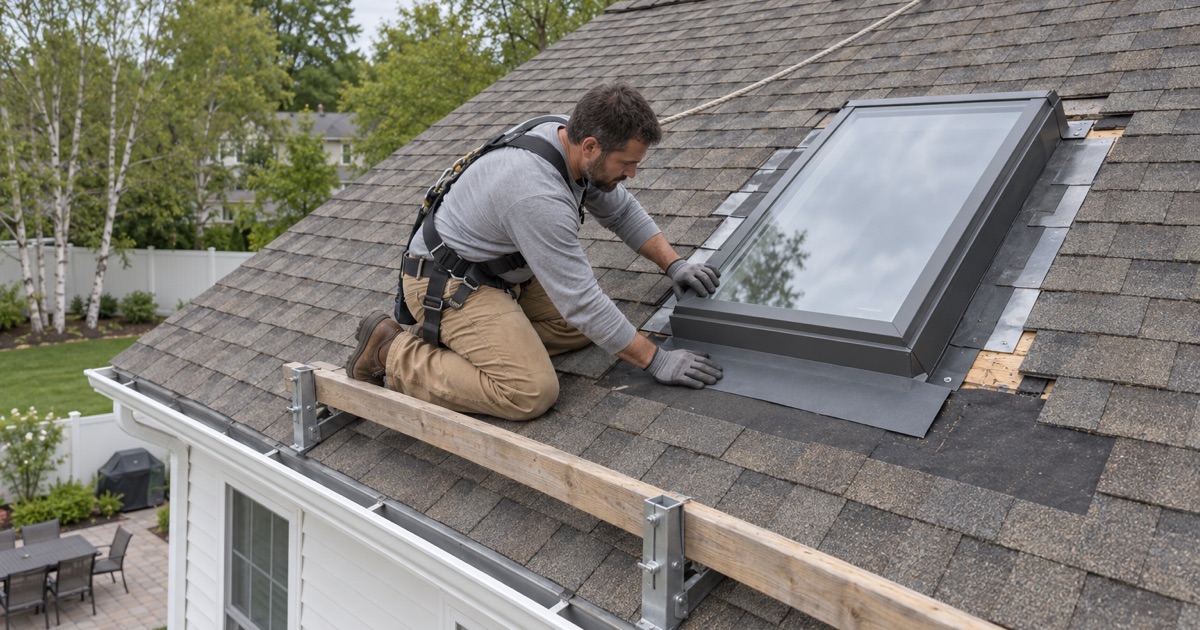
Deck-Mounted Skylights
Deck-mounted skylights fasten directly to the roof deck and use a flashing kit made by the manufacturer for that specific unit. They sit lower on the roof, look cleaner from the street, and are the usual choice on pitched shingle roofs.
Because the flashing kit is engineered for the unit, it is important to use the matching kit rather than general-purpose metal. We install the kit with step flashing woven into the shingles and a self-adhering ice and water barrier around the frame.
Curb-Mounted Skylights
Curb-mounted skylights sit on a raised wooden frame, or curb, built on the roof. The curb lifts the unit above the roof surface, which makes it well suited to low-slope roofs and to replacing older skylights that were installed on curbs originally.
We build or rebuild the curb from sound lumber, wrap it in ice and water barrier, and flash it with step flashing and a head and sill piece so water is directed around the curb rather than against it.
Fixed and Venting Skylights
Fixed skylights bring in light and cost less. Venting skylights open to release hot, humid air from the top of a room, which helps upstairs rooms, bathrooms and kitchens. Many venting units close automatically when rain begins.
We help you choose based on the room, how much ventilation you want, and how easy the unit will be to reach and operate.
Installation Details That Keep a Skylight Dry
Framing the Opening
Installing a new skylight usually means cutting one or more rafters. We frame the opening with proper headers and doubled rafters where needed so the roof structure carries its load around the opening, and we check the attic first so the skylight lands where the framing allows.
We size the opening to the unit exactly, because a skylight forced into a tight opening or shimmed into a loose one will not seat properly with its flashing kit.
Flashing and Underlayment
Around every skylight we install self-adhering ice and water barrier meeting ASTM D1970, lapped up the sides of the frame or curb, then the manufacturer’s flashing kit with step flashing woven into the shingles. The head flashing at the top sheds water to the sides, and the sill flashing at the bottom carries it out onto the roof.
That layering, not caulk, is what keeps water out. Sealant has its place on a few fasteners, but it is never the primary defense.
The Light Shaft and Interior Finish
Between the roof and the ceiling, the light shaft carries daylight into the room. We frame and insulate the shaft so warm room air does not condense on cold surfaces, and we can flare the shaft to spread more light into the room below.
Drywall finishing and painting can be coordinated with your own painter or included in our estimate, whichever you prefer.
Skylight Repair and Replacement
Reflashing a Leaking Skylight
Many leaking skylights have a sound unit and failed flashing, especially when the flashing was installed with roof cement or reused from an earlier roof. In those cases we remove the surrounding shingles, install new underlayment and a new flashing kit, and relay the shingles.
Reflashing costs much less than replacing the unit and solves the leak when the glass and frame are still in good condition.
Leak or Condensation?
Water around a skylight is not always a roof leak. Condensation forms when humid indoor air meets cold glass, and it can drip enough to stain the shaft and ceiling. We check the attic, the shaft and the roof to find the source before recommending work.
If condensation is the problem, a newer insulated unit, better bathroom ventilation or an insulated shaft is usually the answer.
Replacing Skylights During a Roof Replacement
A roof replacement is the best time to replace an older skylight, because the flashing has to be redone anyway and the opening is fully accessible. Replacing it later means cutting into a new roof and reworking new shingles around it.
On every roof replacement, we reflash or replace each skylight as part of the job, so no old flashing is left hiding under new shingles.
Removing Skylights You No Longer Want
Some owners would rather close up an old skylight than replace it, especially one over a room where it adds heat or glare. We remove the unit, frame in the opening to match the surrounding rafters, sheath and shingle it into the roof, and leave the ceiling ready for drywall. Done properly, the closed opening disappears into the roof and stops being a leak risk for good.
- 20+ Years in Business
- Line-Item Written Estimates
- NJ and PA Contracts