Gloucester Township Roofing provides slate roof repair in Gloucester Township, NJ, serving surrounding cities including Pine Hill, Bellmawr, Woodbury, Haddonfield and Mantua, with more than 20 years of experience caring for older roofs that deserve to be kept. We repair natural slate roofs on houses, churches and older commercial buildings across the area, using matching slate and metals meant to last as long as the stone.
A well-made slate roof can outlive several generations of asphalt shingles, but the parts that hold it together do not last as long as the slate. Nails rust, flashing wears through, and individual slates crack when a branch falls or someone walks on them. Most slate roofs that leak still have plenty of good stone left on them.
Older slate roofs are repaired with matching material wherever it can be found, not patched with asphalt shingles or tar from the truck. We give you a plain answer on whether your slate roof is worth keeping, and a written estimate with each part of the repair broken out, before any work begins.
Slate Roof Repairs We Handle
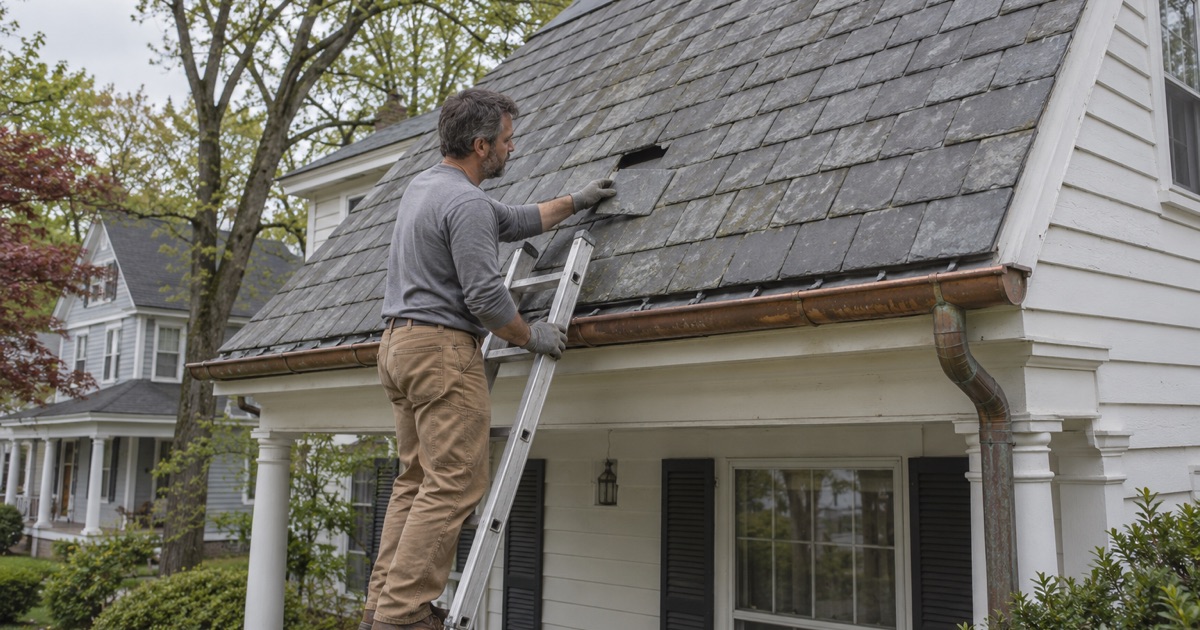
Replacing Broken and Slipped Slates
Broken slates leave a gap that lets water reach the underlayment and deck, and slipped slates, those that have slid down when their nails rusted through, leave the same opening. We remove the broken pieces with a slate ripper, which cuts the old nails without disturbing the slates around them.
Replacement slates are secured with slate hooks or a copper strap, which hold the new piece in place without nailing through the course above. The repair blends into the roof rather than standing out as a patch, and nothing is smeared with tar.
Flashing on Slate Roofs
Slate roofs were traditionally flashed with copper or lead because the stone lasts so long. When flashing at chimneys, valleys, dormers and walls wears out, it has to be replaced with metal that will last as long as the slate around it, or the roof will be opened again in a few years.
We remove the surrounding slates carefully, replace the flashing with copper or another long-life metal, and relay the original slates. Chimney counterflashing is set into a reglet cut into the mortar so it does not depend on sealant.
Ridges, Hips and Valleys
Ridge and hip slates take the most wind and weather, and the mortar or metal at the ridge often fails first. Valleys carry more water than any other part of the roof, and their metal wears through long before the slate around them.
We rebuild failing ridges and hips with matching slate or metal ridge caps, and replace worn valley metal with new copper set over an ice and water barrier meeting ASTM D1970, so the water channel matches the life of the roof.
Snow Guards on Slate
Slate is slick, and snow can slide off in heavy sheets, damaging gutters and anything below. Many older slate roofs carry snow guards that have rusted, broken or pulled loose over time. We replace and add guards using designs made for slate, installed without cracking the surrounding pieces.
Is Your Slate Roof Worth Keeping?
Signs the Slate Is Still Sound
Good slate gives a clear ring when tapped, holds its color and surface, and shows little flaking at the edges. When most of the slates on a roof are in that condition and the leaks come from flashing, nails or a few broken pieces, repair is almost always the right investment.
We check a sample of slates across each slope, not just the ones near the leak, so our recommendation reflects the condition of the whole roof rather than one bad spot.
Soft and Delaminating Slate
Some slates weaken with age, flaking in layers, turning soft at the edges, and giving a dull thud instead of a ring when tapped. A roof with widespread delamination is approaching the end of its life no matter how many repairs it gets.
When that is what we find, we tell you plainly and explain your options, which may include a new slate roof, a synthetic slate, or a high-quality architectural shingle chosen to suit the house.
Nail Fatigue and Widespread Slipping
When many slates are slipping across a roof at once, the original nails have reached the end of their life even if the stone is fine. Spot repairs can keep up for a while, but eventually the better answer is to strip, sort and relay the sound slate on new underlayment with copper nails.
Relaying keeps the original slate on the house and resets the clock on everything that holds it in place.
How We Work on Slate
Protecting the Roof While We Work
Slate cracks underfoot, so we do not walk on it. We work from roof ladders hooked over the ridge, hook ladders and staging that spread our weight, and we set ladders and equipment so they do not crack the courses at the eaves.
That care is the difference between fixing one broken slate and leaving with three more cracked than when we arrived.
Sourcing Matching Slate
We look for new or salvaged slate that matches the color, size and thickness of your roof. Where a perfect match cannot be found, original slates from a rear slope can be moved to the front, with the closest available match used where it is less visible.
Permits, Historic Districts and Paperwork
In New Jersey, repairing or replacing the roof covering on a detached one- or two-family house is ordinary maintenance under N.J.A.C. 5:23-2.7, but some towns have historic districts that review exterior changes, and Pennsylvania townships set their own permit rules. We check both before work starts. Contracts follow the home improvement rules of the state the house is in.
- 20+ Years in Business
- Line-Item Written Estimates
- NJ and PA Contracts