Gloucester Township Roofing completes roof replacement in Gloucester Township, NJ, serving surrounding cities including Pine Hill, Bellmawr, Woodbury, Haddonfield and Mantua, drawing on more than 20 years of tearing off and rebuilding roofs on the houses and commercial buildings in this part of South Jersey and the Philadelphia suburbs. We replace asphalt, slate, metal and flat roofs, and every job is a full tear-off unless there is a specific reason it should not be.
A new roof is a large purchase, and the hardest part for most owners is comparing bids that each describe the work differently. Our estimates separate tear-off, decking, underlayment, flashing, ventilation and gutters into their own lines, so you can lay them beside another roofer’s quote and see where the scopes really differ.
We also start with the question of whether replacement is necessary at all. If your roof can be repaired for several more good years, we tell you before any replacement number is discussed, and when it cannot, we show you the photos that make the case.
Residential Roof Replacement
The Full Tear-Off, Day by Day
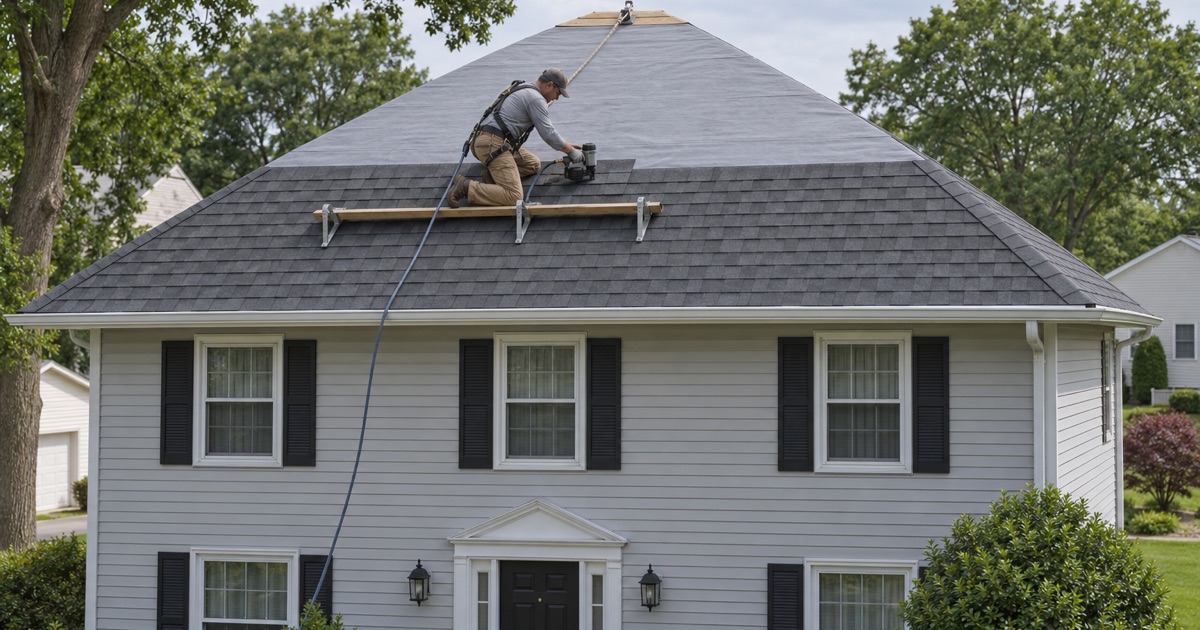
The first morning starts with a dumpster placed where it will not crack the driveway edge, tarps over shrubs, windows and air conditioners, and plywood leaned against siding where debris will fall. The crew strips the old shingles and underlayment down to the deck, one section at a time, so the roof is never left open to weather it cannot handle.
Once the deck is exposed, we inspect every sheet. The new roof goes on in layers from the eaves up, and at the end of each day the gutters are cleared and the yard and driveway get a magnet sweep for roofing nails. The final day ends with a walk-around so you can see the finished roof and the cleaned property together.
Decking, Underlayment and Ice Barrier
Rotted or delaminated decking is photographed and shown to you before it comes out, then replaced at the per-sheet price fixed in your contract beforehand. That way a hidden problem does not turn into an open-ended charge once the old shingles are gone.
Over a sound deck we install drip edge at the eaves and rakes, a self-adhering ice and water barrier meeting ASTM D1970 along the eaves and in the valleys, and a synthetic underlayment meeting ASTM D8257 across the rest of the roof. New Jersey code requires the eave barrier only where the January average is 25 degrees or colder, which leaves out South Jersey, but we still use it in the places ice and wind-driven rain attack first.
New Flashing at Every Wall, Chimney and Valley
Flashing is replaced, not reused. Chimneys get new step flashing tied into counterflashing set in a reglet cut into the mortar, and a cricket behind any chimney wide enough to hold water. Sidewalls get new step flashing and a kick-out at the bottom, and every vent pipe gets a new boot.
Reusing old metal or sealing it over with caulk is one of the most common shortcuts in roofing, and it explains why so many young roofs leak at the chimney. Replacing the flashing during the tear-off costs far less than opening the roof again later.
Ventilation and Attic Airflow
A new roof is the right moment to fix how the attic breathes. We calculate intake at the soffits and exhaust at the ridge by net free area, open painted-over soffit vents or add new ones, and install a continuous ridge vent in place of scattered box vents where the roof allows.
Balanced airflow keeps the deck dry in winter and the shingles cooler in summer, which protects both the roof and the shingle warranty. An attic that cannot exhale is one of the quiet reasons shingles wear out early.
Shingle Choices, Ratings and Color
Most of our replacements use architectural shingles such as GAF Timberline HDZ, Owens Corning Duration or CertainTeed Landmark. We explain their wind ratings under ASTM D3161 Class F and ASTM D7158 Class H, any UL 2218 Class 4 impact-rated options, and the ASTM E108 Class A fire rating they carry, so you know what each upgrade does and does not buy.
Color is chosen on site, not from a brochure. We hold full-size samples against your brick, stone or siding in daylight, because a gray that looks neutral on a board can read green or brown against a red brick front.
Commercial Roof Replacement
Low-Slope Systems for Commercial Buildings
For retail, office and light industrial buildings we replace failed roofs with EPDM rubber, TPO or PVC single-ply membranes, or torch-down SBS and APP modified bitumen. The choice depends on foot traffic, rooftop equipment, drainage and how long you plan to own the building.
Scheduling and Permits on Commercial Work
Commercial roofs fall outside New Jersey’s ordinary-maintenance rule for houses, so we include permit and inspection time in the schedule from the start. Work is staged to keep entrances clear and noise away from business hours where possible.
Permits, Paperwork and Taxes
New Jersey Re-Roof Rules and the Township’s Fee
New Jersey treats replacing the roof covering on a detached one- or two-family house as ordinary maintenance under N.J.A.C. 5:23-2.7, with no permit, inspection or notice required for that work. Attached homes, multifamily buildings and structural repairs still require permits. Gloucester Township’s fee ordinance, O-24-08, sets re-roofing at $30 per $1,000 of work with a $75 minimum, and a flat $75 for an attached single-family roof.
The often-repeated claim that a roof more than 25 percent damaged must be replaced is a Florida rule, not a New Jersey one. New Jersey deleted its own 25 percent roofing limit in 2018.
Pennsylvania Township Permit Rules
Pennsylvania’s statewide code exempts residential repair work, but townships apply it differently to re-roofing, and some list it as permit work outright. For every Pennsylvania job we read the township’s published requirements for that address and quote accordingly, rather than assuming one statewide answer.
Contracts, Cancellation and Sales Tax
Contracts follow the home improvement rules of the state the house is in, including the three-business-day right to cancel in both New Jersey and Pennsylvania. A complete new roof in New Jersey is a capital improvement documented on Form ST-8, while a repair is taxable, so we prepare the form that fits your job.
Replacing Roofs in Special Situations
Roofs Under Solar Panels
Roofs carrying solar panels are scheduled with the panel removal and reinstall planned from the first conversation. We coordinate dates with your solar provider or electrician, replace the roof beneath the array, and flash the new mounts properly before the panels go back on.
Townhouses, Twins and Shared Roofs
About one home in three in the township is not detached, and shared roofs need extra care at the party wall and ridge. We confirm who owns each section, read the association’s rules when the owner can share them, and tie the new roof into the neighbor’s so the seam does not leak.
Moving Up to Slate or Standing Seam Metal
Some owners use a replacement to change materials. Standing seam metal suits low-pitch sections and owners planning to stay for decades, and natural slate on slate hooks suits older homes built for its weight. We check the framing and explain the tradeoffs before you commit.
- 20+ Years in Business
- Line-Item Written Estimates
- NJ and PA Contracts